
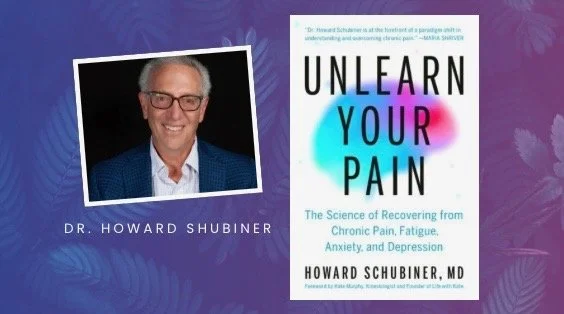
A friend of mine told me about a new book coming out this month I want to share with you. Maybe because May is Women’s Health Awareness Month and soooo many women I know suffer from chronic, unrelenting pain that’s too often dismissed or misunderstood.
Unlearn Your Pain: The Science of Recovering from Chronic Pain, Fatigue, Anxiety, and Depression, by Howard Shubiner, MD, may be the answer to relief.
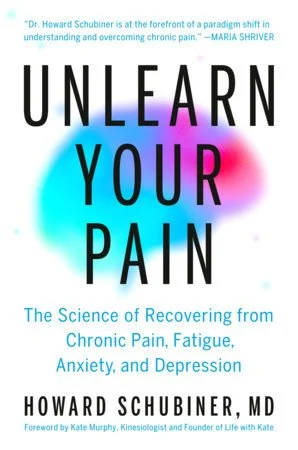
Unlearn Your Pain
“Chronic pain now affects more people than heart disease and cancer combined, with rates rising sharply among younger and middle-aged adults. Millions live with chronic back pain, headaches, irritable bowel syndrome, fibromyalgia, anxiety, depression, and chronic fatigue.
Women are disproportionately affected, experiencing significantly higher rates of conditions such as fibromyalgia, migraines, IBS, and chronic fatigue, and so many more. This discrepancy is likely accounted for by the higher rates of traumatic experiences and pressures placed upon women.”
Dr. Schubiner is an internist and a Clinical Professor at the Michigan State University College of Human Medicine, an author of scientific journals and book publications, and an international lecturer.
In collaboration with colleagues, he’s s developed two novel psychological treatments for chronic pain: Emotion Awareness and Expression Therapy (EAET) and Pain Reprocessing Therapy (PRT), both shown to be highly effective in randomized, controlled trials.
Here’s why I’m intrigued: Unlearn Your Pain challenges longstanding myths about chronic pain and offers a science-based path to recovery. Dr. Schubiner explains how the brain can generate real pain and how it can be retrained to turn it off.
Unlearn Your Pain outlines a comprehensive framework for treatment. The approach begins by validating that symptoms are real, not imagined. It clarifies that many medical diagnoses describe symptoms rather than root causes and explains how the brain can generate physical pain, fatigue, anxiety, and depression through learned neural circuits.
Research increasingly demonstrates a strong link between emotional stress and pain-related neural circuits. The brain operates through prediction, using past experiences to anticipate danger. In many cases of chronic pain, this system misfires, creating a persistent false alarm rather than signaling actual tissue damage.
All pain is real. It can result from tissue damage, but it can also be generated by the brain, even when the body isn’t injured. Injuries heal. Whether pain resolves or becomes chronic is determined by the brain. Through neuroplasticity, the brain learns, adapts, and remembers patterns, including pain. When it continues to perceive danger, pain can stay ‘switched on’ long after the original injury has healed.
“Pain created by the brain is not imaginary or ‘all in your head,’” says Dr. Schubiner. “Suffering is suffering. Chronic pain, anxiety, depression, and fatigue are profoundly real experiences, whether their origin is structural or neuroplastic.”